[자료] IMF 협의단, 26년 한국 연례협의 완료...한국 성장률 26년 3.9%, 27년 3.3% 예상
[뉴스콤 장태민 기자]
자료: IMF
[자료] IMF 협의단, 26년 한국 연례협의 완료...한국 성장률 26년 3.9%, 27년 3.3% 예상
IMF Staff Completes 2026 Article IV Mission to the Republic of Korea
November 17, 2026
End-of-Mission press releases include statements of IMF staff teams that convey preliminary findings after a visit to a country. The views expressed in this statement are those of the IMF staff and do not necessarily represent the views of the IMF’s Executive Board. Based on the preliminary findings of this mission, staff will prepare a report that, subject to management approval, will be presented to the IMF's Executive Board for discussion and decision.
The global artificial intelligence (AI) upcycle is providing an exceptional boost to the Korean economy through record-high semiconductor exports, driving strong corporate earnings and fiscal revenue.
Growth is projected to accelerate to 3.9 percent in 2026 and remain high at 3.3 percent in 2027, while inflation is expected to stay above the 2 percent target in the near term. Harnessing the AI dividend will require a carefully-coordinated tightening of near-term macroeconomic policies to contain demand pressures while mitigating concentration risks amid heightened uncertainty.
Expediting structural reforms to broaden sources of growth, reduce vulnerability to external shocks, and ensure that growth benefits are widely shared would help promote more resilient and inclusive growth.
Seoul: An International Monetary Fund (IMF) team, led by Ms. Corinne Deléchat, Mission Chief for the Republic of Korea, visited the country from November 3 to 17, 2026, to hold discussions for the 2026 Article IV Consultation. At the conclusion of the discussions, Ms. Deléchat issued the following statement:
“The global AI upcycle is providing an exceptional boost to the Korean economy through record-high semiconductor exports, driving strong corporate earnings and fiscal revenue. So far, gains have been largely concentrated in the technology sector, and will only gradually spill over to the broader economy. Sustaining recent gains from the AI upcycle would require addressing longstanding structural headwinds, including rapid population aging, widening regional disparities and uneven productivity growth across firms and workers.
“Real GDP growth is projected to accelerate to 3.9 percent in 2026 from 1.1 percent last year, driven by surging technology exports, rebounding investment and resilient consumption. Growth is projected to remain high at 3.3 percent in 2027, as income gains in the technology sector spill over to consumption, and investments to accelerate Korea’s AI transformation start materializing. These investments are projected to lift potential growth over the medium term. While the authorities’ response helped mitigate the inflationary impact of higher energy prices, inflation is projected to reach 2.7 percent in 2026 and 2.3 percent in 2027 owing to strengthening domestic demand. Uncertainty around the outlook is high, and risks to activity are tilted to the downside.
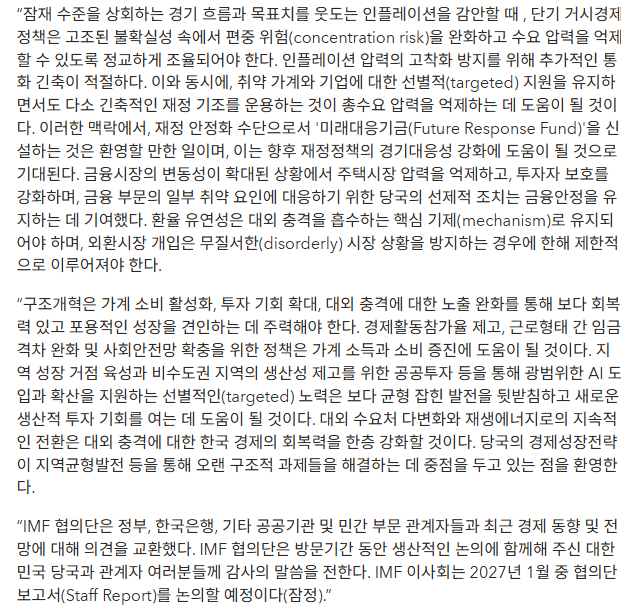
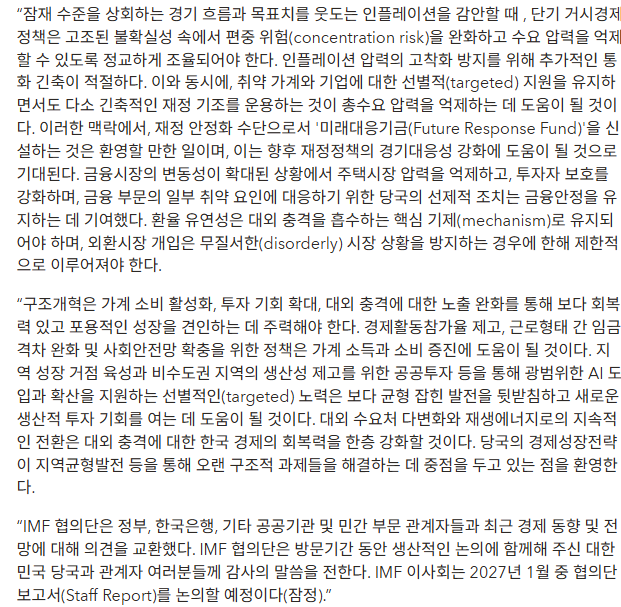
“With the economy operating above potential and inflation above target, macroeconomic policies in the near-term should remain carefully calibrated to contain demand pressures while mitigating concentration risks amid heightened uncertainty. Further monetary tightening is appropriate to prevent inflationary pressures from becoming entrenched. At the same time, a somewhat more contractionary fiscal stance would also help contain aggregate demand pressures, while providing targeted support to vulnerable households and firms. In this context, the creation of the Future Response Fund as a fiscal stabilization vehicle is welcome and should contribute to strengthening the countercyclicality of fiscal policy. Against a backdrop of heightened financial market volatility, the authorities’ proactive measures to contain housing market pressures, enhance investor protection, and address pockets of financial sector vulnerabilities have helped preserve financial stability. Exchange rate flexibility should remain the primary mechanism for absorbing external shocks, and foreign exchange interventions limited to preventing disorderly market conditions.
“Structural reforms should focus on making growth more resilient and inclusive by helping unlock household consumption, enhance investment opportunities and mitigate exposure to external shocks. Policies to raise labor force participation, address wage gaps across different categories of workers and expand social protection would help lift household income and consumption. Targeted efforts to support broader AI adoption and diffusion, including through regional growth clusters and productivity-enhancing public investment outside the Seoul region, would help support more balanced development and open new productive investment opportunities. Diversifying Korea’s sources of external demand and continuing the transition toward more renewable energy would strengthen economic resilience to external shocks. The focus of the authorities’ economic growth strategy on addressing some of these longstanding challenges, including through balanced regional development, is welcome.
“The IMF team exchanged views on recent economic developments and the outlook with officials in the government, the Bank of Korea, other public institutions, and private sector representatives. The team would like to thank the authorities and other interlocutors for the productive discussions. The IMF’s Executive Board is tentatively scheduled to discuss the Staff Report in January 2027.”
장태민 기자 chang@newskom.co.kr